.png)
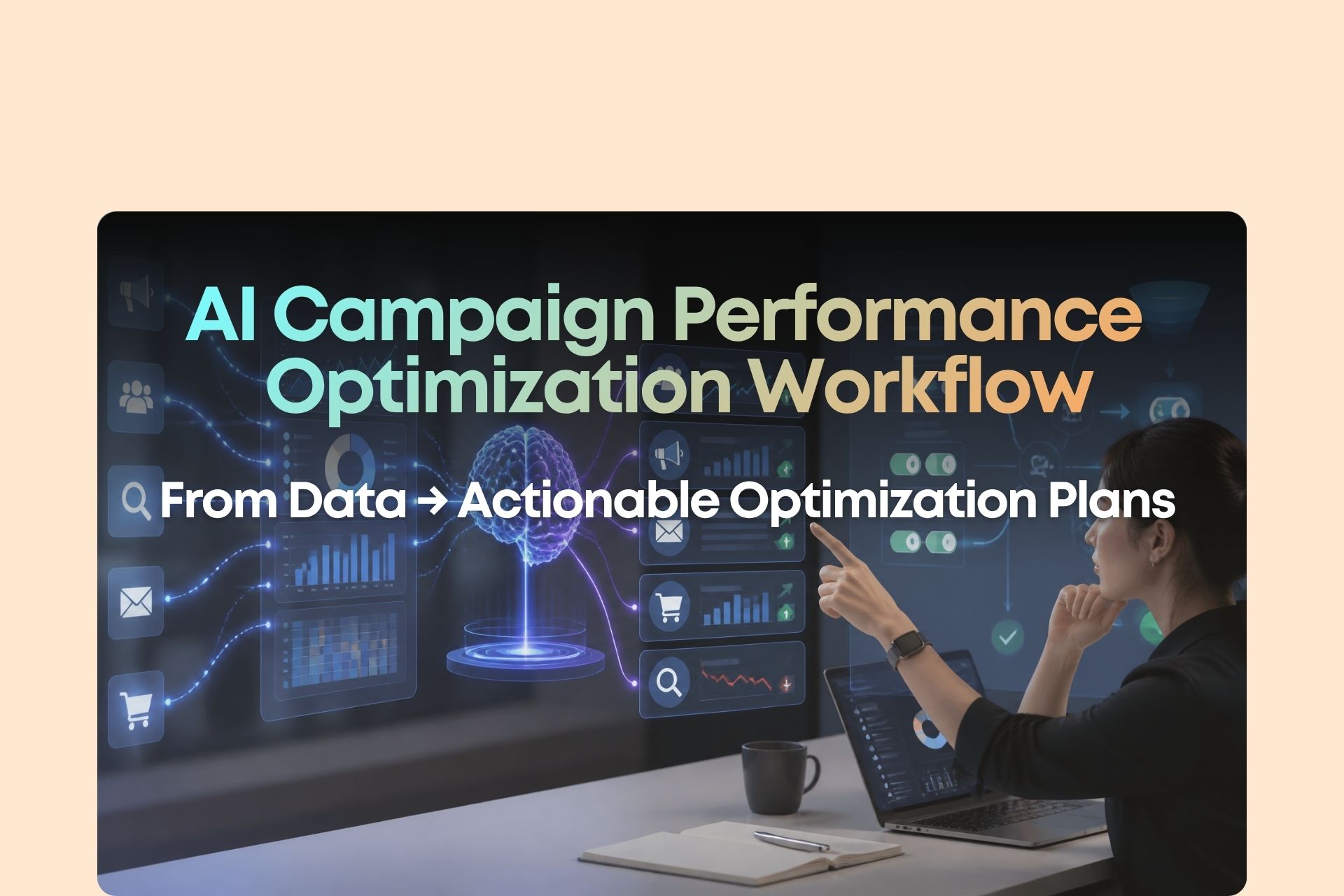
Turn campaign data into actionable optimization plans with AI. Learn a semi-automated workflow to improve CTR, CPA, and ROAS with smarter decisions.
Are You Stuck Looking at Data… But Not Knowing What to Do?
Every day, you open Meta Ads or Google Ads and see:
- CTR dropping
- CPA increasing
- ROAS declining
You know there’s a problem.
But the real challenge is:
👉 What exactly should you change? Where? And how much?
Most performance marketers get stuck here:
- Data → Insight (done)
- Insight → Action (stuck)
And that leads to:
- Random changes (e.g. swapping creatives blindly)
- Over-optimization (resetting learning phase)
- Or worse… doing nothing
“The problem isn’t lack of data — it’s lack of executable decision logic.”
At NextMaven, we’ve helped marketers build AI-powered workflows, and the most effective systems always do this:
👉 Data → Automatically identify issues → Output executable action plans
Not reports. Not dashboards.
👉 Actual decisions you can implement immediately.
This guide breaks down a semi-automated AI Campaign Optimization Workflow (AI + human decision-making).
Step 1|Data Collection (Non-LLM): Your Foundation Matters
No matter how powerful your AI is — bad data = bad decisions.
🎯 Required Data Sources
- Meta Ads API
- Google Ads API
📊 Required Metrics & Dimensions
- Campaign / Ad set / Ad level
- CTR / CPC / CPA / ROAS / Frequency
- Spend / Conversion / Impressions
- Audience / Creative / Placement
⚠️ Two Critical Factors Most People Miss
1️⃣ Time Comparison (Context is Everything)
Always include:
- Last 7 days
- Previous 7 days
👉 Without this, you can’t distinguish trends from noise.
2️⃣ Breakdown (Root Cause Analysis)
You must break down by:
- Audience
- Creative
- Placement
👉 Otherwise, you’ll know what’s wrong, but not where it’s wrong.
Step 2|AI Analysis: From Data Monitoring to Problem Detection
Your AI agent should focus on just two things:
① Performance Benchmarking
Automatically compare against:
- Account average
- Historical best
Example:
- CTR 30% below average → 🚨 Flag
- CPA 25% above target → 🚨 Flag
② Anomaly Detection
Using rule-based + simple ML:
- Sudden CTR drop
- CPA spikes
- High frequency (creative fatigue)
- Spend increases but conversions stay flat
🔍 Example Output
Ad Set A
- CTR ↓ 40% (vs last week)
- Frequency = 4.2
👉 Status: Creative fatigue
“AI shouldn’t just show data — it should highlight problems automatically.”
Step 3|Strategy Generation: From Insights → Decision Logic
This is where most workflows fail.
Typical output: “Try new creatives”
👉 That’s not enough.
You need a Decision Engine.
① Rule-Based Decision Engine (Core Layer)
Turn data into rules:
Examples:
- IF CTR low + high impressions
→ Change creative angle - IF CPA high + CTR normal
→ Fix audience targeting - IF Frequency > 3.5
→ Refresh creative - IF ROAS below target + high spend
→ Pause ad set
② AI-Generated Execution Plans
Not just what to do — but how to do it
Creative Suggestions:
- New hooks
- UGC / testimonial / demo formats
Audience Suggestions:
- Lookalike expansion (e.g. 3% → 5%)
- Interest expansion
③ Prioritization (Most Overlooked)
Not everything should be optimized.
🎯 Priority Rules:
- 🔴 High: High spend + low performance
- 🟡 Medium: Moderate issues
- ⚪ Low: Low spend → monitor
“Optimization isn’t about doing more — it’s about fixing what impacts ROI most.”
Step 4|Human Approval: AI is Not Autopilot
AI suggests. Humans decide.
👨💻 Your Role as a Marketer:
- Validate AI recommendations
- Avoid changing too many variables
- Prevent learning phase resets
⚠️ Guardrails (This Determines Success or Failure)
Without guardrails, automation becomes dangerous.
1️⃣ Budget Protection
👉 Do not pause more than 30% of total spend at once
2️⃣ Learning Phase Protection
👉 No changes for campaigns under 3 days
3️⃣ Change Limits
Per cycle:
- Max 2–3 ad sets
- Max 1–2 variables
4️⃣ Confidence Threshold
👉 Low conversion volume = no action
💡 Deliverable: Stop Sending Reports — Start Sending Plans
Your AI output should be:
👉 Weekly Optimization Plan
🚨 1. Key Issues
Top 3 problems:
- Rising CPA
- Dropping CTR
- High frequency
🎯 2. Action Plan
Priority
Campaign
Issue
Action
🔴 High
Campaign A
High CPA
Pause Ad Set 3
🔴 High
Campaign B
Low CTR
Test new hook
🟡 Mid
Campaign C
High frequency
Refresh creative
🧪 3. Testing Plan
- Test 1: New UGC angle
- Test 2: LAL 3% → 5%
📊 4. Expected Impact
- CPA ↓ 15–25%
- CTR ↑ 20%
🚀 How to Apply This (Step-by-Step)
Want to build this system from scratch?
Follow this framework:
Step 1: Data Pipeline
- Use APIs / Zapier / Make
- Store in Google Sheets / Airtable
Step 2: AI Analysis Layer
- Use GPT / Claude for benchmarking
- Add rule-based anomaly detection
Step 3: Decision Engine
- Build IF/THEN rule library
- Continuously refine
Step 4: Output Template
- Standardize Weekly Plan format
- Make it execution-ready
💡 Content Upgrade Idea:
Download “AI Campaign Optimization Template (Notion + Prompts)”
🔥 Bonus: Advanced Strategies
1️⃣ Auto-Generated Creative Briefs
AI outputs:
- Hook
- Script
- Visual direction
2️⃣ Cross-Channel Learning
Analyze Meta + Google together:
👉 Identify winning angles
3️⃣ Feedback Loop (Most Important)
Feed results back into the system:
- Success → reinforce rules
- Failure → adjust logic
“The real advantage isn’t AI — it’s a system that gets smarter over time.”
Conclusion: From Analyst to Decision System
The future of performance marketing is not:
👉 Analyze → Think → Slowly test
It’s:
👉 AI detects → System recommends → Humans approve → Rapid iteration
Once you implement this workflow:
- Decision speed increases 3–5x
- Fewer optimization mistakes
- More stable ROI
Most importantly:
👉 You stop being the person who reads data — and become the one who controls the system.